Digital Twins as enablers of Positive Energy Districts: insights from the TIPS4PED project
December 17, 2025
The TIPS4PED introduction video is now live
January 12, 2026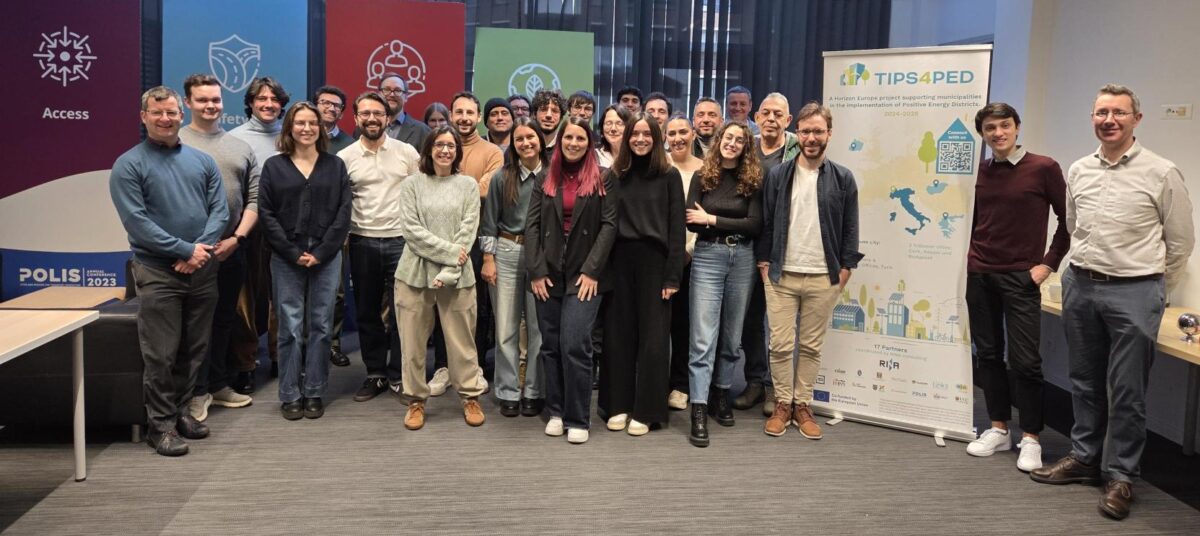
Turning Planning Actions into Success for Positive Energy Districts with our latest project meeting and consortium workshops.
The Horizon Innovation Action TIPS4PED (Turning Planning Actions into Success for Positive Energy Districts) convened its 24month General Assembly in the POLIS Network offices in Brussels. Representatives from the four partner cities of Turin (Italy), Kozani (Greece), Kőbánya (Hungary) and Cork (Ireland) joined the rest of our partner organisations from across Europe to review progress, validate the IAP (Integrated Assessment Platform) Digital Twin-based platform, and chart the path toward the 2026 national roundtables and the next Cities Mission Climate Conference in Turin.
Energy and Mobility services deployment: developing the modules that will feed the Integrated Assessment Platform.
Colleagues from IES, RINA Consulting, Politecnico di Torino and CIRCE Centro Tecnológico and LINKS provided a comprehensive overview of the work undertaken in Work Package 2 as it nears completion at the end of 2025. The development of these individual monitoring modules will provide the Integrated Assessment Platform with the necessary data to establish the feasibility of implementing a PED.
These modules include: Local energy sources and building energy demand mapping, Scenario planning and simulation, Mobility monitoring (private EV fleets, public transport, micromobility services), Energy conversion and storage analyses, Integrated master planning for urban infrastructure, real estate and other energy assets, and more!
Ultimately, these modules will allow the IAP to provide us with a PED Readiness Indicator, a mock-up of which is displayed below:
Over the next year, the IAP will be put through its paces in our Lighthouse City Turin, with the ultimate goal of providing continuous performance monitoring and operational optimization of PEDs through the use of calibrated digital twins. Its purpose is to ensure that PEDs maintain energy positivity over time by dynamically adjusting operational strategies based on real-time data and predictive simulations.
This IAP will then be replicated in our Follower Cities within the project, and this General Assembly provided them with an opportunity to comment on the work being done in Turin so far, as well as highlight any potential obstacles to implementation within their local contexts. To this end, we rounded off the General Assembly with a group exercise in which the cities (along with designers and other partners) had to workshop on PED value propositions & market fit. This exercise was designed and led by LUT and saw participants brainstorming which specific problems their own PEDs were faced with. For example, in Kozani, the transport network was identified as an area that would benefit from investment as part of the development of a PED, with the goal of perhaps establishing an integrated electric bus charging network.
Looking ahead, there is plenty of work to do on the topics of standardization, the implementation of national PED roundtables in each of the four countries, and all this alongside the continued testing of the IAP within Turin’s PED.
Standardization – key to a successful PED roll-out
On 17 December, ICLEI led a second workshop, this time focused on arriving at a CEN Workshop Agreement (CWA) for effective standardization that meets the requirements from CEN (European Centre for Standardisation) to eventually achieve formal European Standards for PED Digital Twins.
A CWA is a fast-track, consensus-based document created by stakeholders through a collaborative workshop, providing best practices, guidelines, or technical specifications in a specific area, acting as a bridge before formal European Standards (ENs), and is voluntary but influential for future standards.
This workshop began with a guest appearance from UNI (the Italian body of CEN) with Giacomo Riccio providing their perspective on what constitutes an effective CEN workshop Agreement. Primarily, this workshop focused on identifying the scope of the CWA and the required workplan for 2026. Notably, it was mentioned that defining the scope of a PED is a crucial first step within the standardization process, as there exist varying standards in terms of physical size of a district and other requirements to be considered energy positive.
There will be plenty of developments across the scope of the entire project in 2026! Make sure to subscribe to our channels on LinkedIn, YouTube, and the Newsletter to ensure you stay up to date with TIPS4PED.